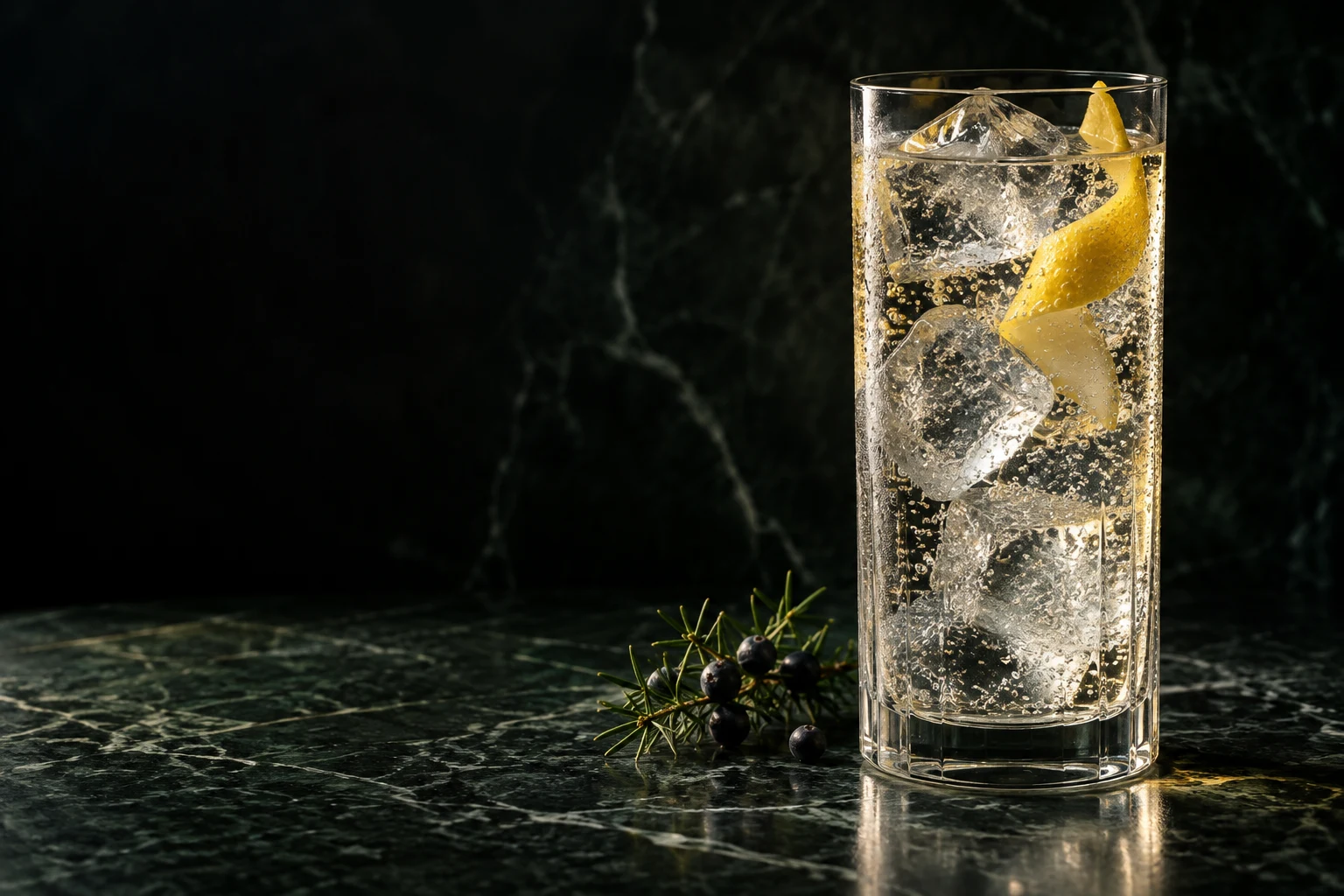
Gin and tonic didn’t start life together. One came from Europe’s juniper spirits. The other began with a South American tree. Getting them into the same glass took a while.
THE GIN SIDE / THE LOW COUNTRIES
Meet the Dutch cousin.
Before London Dry, there was genever: a juniper-flavoured spirit from the Low Countries. By 1552, a recipe had made it into an Antwerp distilling book. Gin’s family tree was already putting down roots. [01]
And “Dutch courage”?
The old yarn has English soldiers noticing Dutch troops steadying their nerves with a nip of genever. They bring a taste for it home. A fine bar story—and best enjoyed as folklore.
THE TONIC SIDE / THE ANDES
The bitter bit.
Cinchona bark was known to Indigenous Andean peoples long before tonic came in a bottle. Its medicinal reputation carried it into European trade. In 1820, chemists isolated quinine: the bitter compound that would become tonic’s calling card. [02][06]
Gin gets cheap. Gin gets everywhere. After restrictions on French spirits and easier home-grown distilling, London develops a serious thirst—and an equally serious problem.
By 1751, Hogarth’s Gin Lane is shouting about it in print. Crumbling buildings. Pawned possessions. Chaos in the street. Subtle, it is not.
This is satire with a mission: make gin look like a city’s downfall. Licensing laws, rising grain prices and shrinking incomes eventually help cool the craze. [03][04]
PULL UP A CHAIR / THE SOLDIERS’ YARN
Medicine is bitter. Gin is available. You see where this is going.
The familiar story goes like this. British officers in India are taking quinine against malaria. It’s fiercely bitter, so in go sugar and water. Then someone reaches for the gin. A grim duty becomes a rather more appealing evening ritual.
That’s the lore. The paper trail puts a named gin and tonic at the races in Lucknow in 1868. Either way, by then the two are keeping company. [08]
The short version for history nerds
The medicinal roots are real; the cocktail’s exact invention is harder to pin down. Modern tonic is a mixer, not malaria protection. [02][08]
Erasmus Bond patents tonic water in 1858. Schweppes adds Indian Tonic Water in 1870. You no longer need to be an officer—or an amateur apothecary—to get your hands on the mixer. [08][10]
Meanwhile, cleaner base spirits help gin move towards the crisp, dry style we now think of as the classic. By the early 1900s, London Dry has taken centre stage. [07][11]
Take the scenic route: the full timeline11 stops, from genever to London Dry
11 milestones
1552
JUNIPER / GIN
Before gin, there was genever.
A printed jenever recipe appears in Philippus Hermanni’s Antwerp distilling book. The juniper habit is already in print. [01]
Look closer
Genever is gin’s older cousin. Early recipes could start with wine spirit; the modern grain-spirit styles came later.
1600s
CINCHONA / TONIC
A bark with a much older story.
Cinchona enters European trade from the Andes. Kew credits Quechua, Cañari and Chimú peoples with recognising its medicinal properties. [02]
Look closer
The precise first discovery is not established. Calling cinchona a European discovery erases the Indigenous knowledge at the beginning of this story.
1689–1751
JUNIPER / GIN
Politics, cheap spirits and the Gin Craze.
Restrictions on French spirits and easier domestic distilling helped gin grow in England. The Gin Acts tried to curb consumption; grain prices and falling incomes also mattered. [03][04]
Look closer
A £50 retail licence in 1736 encouraged evasion. Further controls arrived in 1751, the year of Hogarth’s Gin Lane. That famous print is campaigning satire, not a neutral portrait of every Londoner.
Early 1800s
JUNIPER / GIN
Gin was not always dry.
Sweetened English gins included the style known as Old Tom. Its later place in the Martini and Gin Fizz connects today’s cocktail culture to a sweeter past. [05]
Look closer
Old Tom is a historical style with variation between producers. The famous black-cat origin story should not be treated as established fact.
1820
CINCHONA / TONIC
Quinine is isolated.
Pelletier and Caventou isolate quinine from cinchona bark. The bitter ingredient at the heart of tonic now has a name and a purified form. [06]
Look closer
Quinine is one compound in cinchona bark. Bark preparations, purified quinine, carbonated tonic water and the mixed drink are four different things.
1830s
JUNIPER / GIN
A cleaner canvas for botanicals.
Aeneas Coffey’s continuous still helps make highly rectified spirit practical. Cleaner base spirits support the later development of drier gin styles. [07]
Look closer
Cleaner base spirit gives juniper and the other botanicals more room. London Dry develops over time, rather than arriving with a single invention.
1850–1865
CINCHONA / TONIC
A botanical becomes an imperial commodity.
Cinchona plants and seeds move to colonial plantations in India and Java. Quinine’s supply becomes entangled with empire, plantation labour and control of land. [08][09]
Look closer
Kew’s own history acknowledges its role in these transfers. The story includes the people and landscapes behind the commodity.
1858
CINCHONA / TONIC
Tonic gets a commercial milestone.
Erasmus Bond patents tonic water, marketed as a digestive and restorative. Bitter bark has made its way into the fizzy-drinks business. [08]
1868
THE GIN & TONIC
The two stories meet in print.
Kew’s researchers identify the earliest known named gin-and-tonic reference: racegoers in Lucknow, India, call for the drink in the Oriental Sporting Magazine. [08]
Look closer
A day at the races, a gin and tonic: the drink is already part of social life by this point.
1870
CINCHONA / TONIC
The mixer becomes a familiar bottle.
Schweppes dates its Indian Tonic Water to 1870. Commercial tonic carries a complex botanical history into an increasingly everyday refreshment. [10]
c. 1900
JUNIPER / GIN
London Dry comes to the fore.
By the early twentieth century, London Dry is gin’s predominant style. A drier, juniper-led profile becomes the reference point for generations of drinkers. [11]
Look closer
London Dry describes a style and production rules. It does not require the gin to be made in London.
London Dry was a classic. Then a new generation started asking what else gin could be. The answer came by a wonderfully roundabout route.
England had the tradition. The experiments were happening all over the map.
California had a growing craft-distilling spirit. France put Cognac know-how to work on gin. Scotland arrived with rose and cucumber. This was a whole new set of reasons to look twice at the bottle.
Back in London, Sipsmith’s big idea was wonderfully small: a 300-litre still, proper copper distillation and a fresh take on a very old style. In 2009, after a long licensing battle, it was finally time to make gin. [42]
1982
ST. GEORGE / A DIFFERENT WAY OF THINKING
First, capture the fruit.
Jörg Rupf starts St. George in California making eau-de-vie: fruit brandy with the character of the fruit turned right up. The distillery’s gin comes later. First comes the craft instinct—start with something wonderful, then find a way to bottle it. [40]
MEANWHILE / THE MIXER WANTS A WORD
Lovely gin. Shame about the tonic.
Tim Warrillow and Charles Rolls saw the opening. If people were getting excited about what went into gin, why was the mixer an afterthought? Fever-Tree launched in 2005, giving tonic a story of its own. [22]
Then an artist went shopping.
01 / THE SUPERMARKET
Richard Hamilton finds a bottle.
The artist spots Fever-Tree at Waitrose. He likes it enough to send a bottle to his friend Ferran Adrià, via a journalist heading to see the chef.
02 / THE KITCHEN
It takes a detour through elBulli.
Adrià’s team asks for more. The tonic becomes a granita at elBulli: an unexpectedly glamorous destination for a supermarket discovery. [34]
03 / THE BREAKTHROUGH
Spain gets interested.
The connection gives Fever-Tree a spectacular introduction to Spain—just as the country’s gin-tonic culture is finding a bigger audience. [35]
Spain already had its own love affair with the gin-tonic. Chefs and bartenders treated it as something worth lingering over, not just knocking together. An after-dinner drink could become an evening.
By 2010, a first-person account of José Andrés’s serve describes Hendrick’s and Fever-Tree with lime, a long lemon peel and a red flower. That modest slice of citrus had clearly been promoted. [37]
Out comes the big balloon glass. In goes a generous pile of ice. Then the aromatics: citrus peel, herbs, flowers, peppercorns. The garnish becomes part of the drink’s personality—and the whole thing arrives with a little theatre. [36]
Fever-Tree didn’t invent that culture. It found a very good home in it.
A BIG GLASS+PLENTY OF ICE+A LITTLE SHOWMANSHIP=the gin-tonic
YOUR TURN / GIVE IT A SPANISH ACCENT
What’s going in your glass?
Pick a garnish or two. Think of this as dressing the drink: enough to give it character, without losing the gin underneath.
THE PURIST
Let the gin do the talking.
No garnish is a perfectly good place to begin. Pick one above and see what it brings.
AND THEN THE PHONE CAME OUT.
A balloon glass. A curl of citrus. A tiny garden. This drink was ready for its close-up.
Social media gave the spectacle another stage. By 2019, Martin Miller’s social-media team was talking about influencer campaigns, drinkers recreating bar serves at home, and strawberry-and-black-pepper G&Ts catching attention online. [38]
Instagram didn’t invent the Spanish gin-tonic. It was a very good place to show one off.
AND THEN / EVERYWHERE
What does your corner of the world taste like?
Once gin can taste like a place, the map opens up. Singapore, Japan and Australia all have something to bring to the glass.
01 / SINGAPORE
Tanglin Orchid Gin
Vanilla orchid and amchoor join traditional gin botanicals. [24]
02 / JAPAN
Roku
Sakura flower and leaf, yuzu, sencha, gyokuro and sansho form six Japanese botanicals. [25]
03 / AUSTRALIA
Four Pillars Rare Dry
Queensland lemon myrtle and Tasmanian pepperberry leaf sit alongside other local and imported botanicals. [26]
THE OTHER HALF OF THE STORY
The mixer has a flavour, too.
Tonic brings bitterness, sweetness, acidity, carbonation and aroma. Product names such as “Mediterranean” describe styles rather than regulated categories.
Classic Indian
A quinine-led tonic with citrus aromatics is a useful reference point. Fever-Tree’s version is one example, not a definition of every brand. [29]
Herb-led
Some Mediterranean-style tonics add herbal notes. Fever-Tree names rosemary and lemon thyme. The label alone does not tell you every product’s quinine level. [30]
Floral
Elderflower adds another aromatic layer. Compare it with a simpler tonic to hear what it changes in the gin. [31]
Light
“Light” need not mean sugar-free. Check the bottle: this UK cucumber-tonic example uses fruit sugar, and recipes can differ by market. [32]
03 / WHAT’S IN THE BOTTLE?WHAT MAKES GIN, GIN?
A piney little berry. A lot of possibilities.
Juniper is the family resemblance. The rest is where distillers get to have fun: citrus, roots, herbs, flowers, spice. Pick a style and get to know it.
01
The base
Fermentation produces alcohol. Distillation concentrates it; a highly rectified base gives botanicals room to define the spirit.
02
The botanicals
Juniper provides the defining character. Citrus peels, seeds, roots, herbs and spices build the rest of the flavour.
03
The method
Producers may steep botanicals, use vapour infusion, or combine techniques. Some gins are compounded with flavourings.
The label nerd’s corner
In the EU, gin must be predominantly juniper-flavoured and at least 37.5% ABV. “Distilled gin” and “London gin” have additional production rules. [12] Great Britain uses a separate retained framework; Northern Ireland follows the EU regulation. [13]
STYLES & LABELS YOU’LL ENCOUNTER
Same family. Different personalities.
These labels overlap. They are not five mutually exclusive legal categories.
A DEFINED PRODUCTION CATEGORY
London Dry
Botanical flavour is introduced through distillation. Colouring is prohibited, and sweetening is limited to 0.1 g per litre, expressed as invert sugar. London refers to the production rules, not the distillery’s address.
Try it to understand the classic juniper-led reference point.
Does London Dry require botanicals to touch the liquid?
No. The EU rules require the natural plant materials to be present during distillation; they do not require every botanical to be submerged. Vapour infusion can be used. Bombay’s own London Dry is a concrete example of vapour infusion. [14][12]
04 / THE PAIRING LABMAKE IT YOURS
The best ratio? Start exploring.
Start with one part gin to two parts tonic. Then have a play. More tonic? A splash of soda? A different garnish? Your taste gets the final vote.
01 / FIND YOUR BALANCE
Build a glass.
Start with a 50 ml measure of gin.
37.5%60%
0 ml50 ml
ESTIMATED DRINK STRENGTH
13.3%ABV
50 ml gin + 100 ml tonic
GinTonicSodaMeltwater
Before ice melt, a 1:2 serve is two thirds mixer. Its flavour matters.
THE MATH
50 × 40 ÷ 150 ≈ 13.3% ABV
Approximation assuming additive liquid volumes and alcohol-free mixers. Ice itself is excluded until it melts. Dilution changes concentration; the amount of alcohol from the gin stays the same.
02 / FOLLOW THE FLAVOUR
What stands out in your gin?
What do you notice first: pine, citrus, flowers, herbs or spice? Follow that thread. There’s no answer sheet.
Give the pine room.
MIXER TO TRY
A restrained Indian tonic.
GARNISH TO TRY
A small lemon peel.
Compare with and without the peel. Does it lift the aroma or crowd the gin?
A quick detour into flavour science
WHY A SPLASH MAKES A DIFFERENCE
Less burn. More room to explore.
Alcohol has a taste and a burn of its own. One reason is TRPV1, a receptor involved in heat and irritation. Adding tonic changes that experience. [15]
Water also changes how aroma compounds behave. There isn’t a magic percentage that unlocks every gin; try a little, smell again, and notice the difference. [16]
TRY A FAIR COMPARISON
Keep the gin, glass and temperature the same. Change just the tonic or ratio. Smell first, take a small taste, and notice sweetness, bitterness, aroma and finish.
03 / PUT IT INTO PRACTICE
01
Keep it cold.
Start with a chilled mixer and plenty of fresh ice. Temperature is part of the experience.
02
Measure first.
Try 1:2, then adjust to your taste. Asking for tonic on the side makes comparison easier.
03
Find your flourish.
A peel, a sprig, a peppercorn. Start with one good idea, then taste before planting the whole garden.
05 / DOWN THE RABBIT HOLEFOR THE DELIGHTFULLY CURIOUS
Fancy another rabbit hole?
Old prints, distillers’ stories, a supermarket discovery and a little science. Here’s where we went looking—and where you can keep reading.
HOW THIS GUIDE WAS RESEARCHED
Museums and archives for the old stories. Interviews and distillers’ own accounts for the revival. Original studies for the science. The soldiers’ tale stays in the bar-lore corner, where it belongs.
WHAT TO KEEP IN MIND
History rarely comes with a tidy invention date. We’ve kept the useful distinctions in the notes and the tasting suggestions in the spirit of experimentation. Follow any numbered link for the source.
If you’re curious about the business side
THE MARKET / EVIDENCE, NOT A BOOM NARRATIVE
There is no single global direction.
ASIA PACIFIC · ALL GIN
+11%
Volume growth in 2024
Annual change across the region, reported by IWSR in June 2025. [17]
UK · PREMIUM-AND-ABOVE GIN
−12%
Annualised decline, 2020–24
Volume compound annual growth rate, reported by IWSR in August 2025. [18]
GLOBAL TRAVEL RETAIL · FLAVOURED GIN
−7%
Volume decline in 2025
A specific channel and subcategory, reported by IWSR in August 2026. [19]
Read these separately: different geographies, segments, periods and measures. They are not directly comparable or a complete global market estimate. Research checked 3 October 2026.
The good stuff behind the story
48 REFERENCES
The comeback, Spain & the archive images15 sources
Fever-Tree · product example, UK market · contains fruit sugar
Adapted from The Spiffy Dapper’s Gin & Tonic Masterclass. Research checked 3 October 2026. Hero still life: AI-generated. Historical images: credited public-domain scans.